
A home office with bare walls isn’t just uninspiring, it’s a missed opportunity. The right wall treatments turn a functional workspace into a focused, productive environment that actually feels professional. Whether you’re working with a dedicated room or a carved-out corner, what goes on your walls influences mood, organization, and even how seriously clients take Zoom calls. This guide covers seven practical approaches to home office wall decor, from gallery walls that motivate without distracting to functional shelving that earns its real estate. No fluff, just proven strategies to make those vertical surfaces work harder.
Table of Contents
ToggleKey Takeaways
- Home office wall decor reduces visual monotony, signals work mode, and provides functional storage that directly impacts focus and productivity during long work sessions.
- Gallery walls and statement art should be strategically positioned outside your primary sightline to avoid competing with screen work while remaining visible during breaks.
- Functional wall decor like floating shelves and pegboards must be properly anchored into studs or heavy-duty wall anchors to safely hold weight and prevent sagging over time.
- Acoustic elements such as fabric-wrapped panels, canvas art, and textile hangings absorb sound frequencies and improve video call quality without professional soundproofing.
- Color psychology matters: cooler tones (blues, grays, greens) support concentration for analytical tasks, while warmer accents spark creativity in your home office environment.
- Simple DIY projects like framed fabric samples, custom pinboards, or peel-and-stick wallpaper accent walls allow you to test designs affordably before committing to permanent installations.
Why Wall Decor Matters in Your Home Office
Wall decor in a home office serves three distinct purposes: it reduces visual monotony that drains focus over long work sessions, provides cues that shift the brain into work mode, and offers functional storage that keeps task-relevant items visible and accessible.
Acoustic performance is often overlooked. Hard, bare walls bounce sound, making video calls echo and creating fatigue during extended meetings. Fabric-wrapped acoustic panels, thick canvas art, or even textile wall hangings absorb mid-range frequencies and improve call quality without requiring soundproofing contractor work.
Color psychology plays a measurable role. Cooler tones (blues, grays, greens) support concentration for analytical tasks, while warmer accents (terracotta, mustard, coral) spark creativity. That doesn’t mean painting entire walls, strategic placement of framed prints or color-blocked panels can zone a multipurpose room.
Avoid turning the office into a living room. Overly personal or cluttered walls compete for attention. The goal is intentional decor that supports workflow, not decorative overload that becomes visual noise.
Gallery Walls That Inspire Productivity
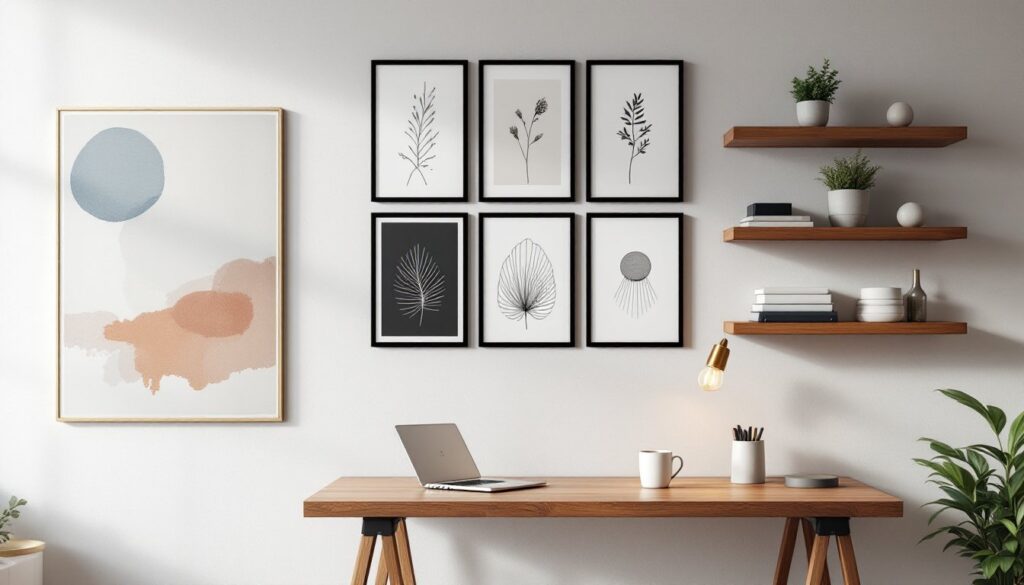
A gallery wall only works if it’s curated around a theme, scattered random prints feel like visual clutter. Choose a connecting thread: monochrome photography, botanical illustrations, vintage patent drawings, or a color story that ties to your office palette.
Layout planning prevents the most common mistake: hanging frames one at a time and ending up with awkward spacing. Trace each frame on kraft paper, arrange the paper templates on the wall with painter’s tape, then step back and adjust before driving a single nail. For an 8×10 grouping, maintain 2–3 inches between frames for cohesion without crowding.
Hanging hardware matters more than most DIYers realize. Standard picture hangers rated for 10–20 lbs work for lightweight frames, but anything over 5 lbs per frame should use wall anchors if you’re not hitting a stud. For drywall, toggle bolts or molly anchors distribute weight and prevent sagging over time. A laser level keeps horizontal alignment tight, eyeballing it leads to subtle slopes that nag at you during every Zoom call.
Keep the gallery wall opposite or perpendicular to your primary sightline, not directly behind your monitor. You want it visible during breaks or when leaning back to think, not competing with active screen work.
Functional Wall Decor: Shelving and Organization
Floating shelves, pegboards, and wall-mounted organizers turn dead wall space into active storage, but only if installed correctly and loaded within capacity.
Floating shelf installation requires finding studs or using heavy-duty anchors rated for the anticipated load. A typical 24-inch floating shelf bracket can handle 25–50 lbs when anchored into studs, but only 10–15 lbs with drywall anchors. Don’t guess, use a stud finder (magnetic or electronic) and mark stud centers with painter’s tape before drilling.
For a clean look, mount shelves at 12–18 inches above desk height to keep frequently used items within arm’s reach without crowding the desktop. Stagger shelf depths: narrower shelves (6–8 inches) for books and binders, deeper ones (10–12 inches) for storage boxes or plants.
Pegboard systems offer flexibility that fixed shelving can’t match. Modern metal pegboards come in matte black, brass, and white powder-coat finishes that look deliberate, not garage-workshop. Mount pegboard panels on furring strips (1×2 lumber) to create the standoff space required for peg insertion. Secure strips to studs every 16 inches for stability.
Wall-mounted file holders, mail organizers, and magazine racks keep paper-based tasks visible. Just avoid the trap of “organizing” clutter instead of eliminating it, if you haven’t referenced that binder in six months, it belongs in archival storage, not on display.
Statement Art and Large-Scale Pieces
A single large piece (36×48 inches or bigger) anchors an office faster than a dozen small ones. It reads as confident and intentional, and it doesn’t require the spatial planning gymnastics of a gallery wall.
Sizing guidelines: For the wall behind a desk, the art should span roughly two-thirds to three-quarters of the desk width. A 60-inch desk pairs well with a 40–50 inch wide canvas or framed print. Hang the center of the piece at 57–60 inches from the floor (standard gallery height), adjusting slightly if you sit most of the day and the piece is in your primary sightline.
Large-scale art doesn’t have to mean expensive originals. Many designers looking to build their DIY decor projects use engineer prints (oversized prints on bond paper) mounted to foam core or stretched canvas. The result looks high-end at a fraction of framed art costs.
Framing options: Metal frames (aluminum or steel) read modern and industrial. Wood frames in walnut or oak warm up minimalist spaces. For a budget-friendly option, canvas stretcher bars from art supply stores let you DIY-frame fabric, oversized prints, or even wallpaper samples for a custom look.
Avoid overly trendy subjects, meme-style prints or buzzword typography age poorly. Abstracts, landscapes, architectural photography, and classic design posters have staying power and won’t distract during client calls.
Textural Elements: Wallpaper, Panels, and Wall Hangings
Texture adds depth that flat paint can’t deliver. Wallpaper accent walls, board-and-batten paneling, and textile hangings introduce dimension without sacrificing wall space.
Peel-and-stick wallpaper has improved dramatically, modern versions use repositionable adhesive that doesn’t damage paint and removes cleanly. Apply it to one accent wall (typically the wall opposite your desk or behind it) to avoid overwhelming the room. Patterns like subtle geometric, linen texture, or grasscloth add interest without distraction. Avoid high-contrast or busy patterns that compete with screen work.
For installation, start at the ceiling and work down, using a smoothing tool (plastic squeegee or wallpaper brush) to eliminate bubbles. Overlap seams slightly, then use a straightedge and utility knife to cut through both layers for a perfect seam.
Board-and-batten or picture-frame molding adds architectural interest and is a solid weekend DIY. Use MDF boards (1×4 for vertical battens, 1×3 for caps and bases) primed and painted to match or contrast your wall color. Find studs, attach vertical battens with finishing nails and construction adhesive, then fill nail holes with spackle and caulk seams before final paint. The result mimics high-end millwork at a fraction of contractor cost.
Textile wall hangings, woven pieces, macramé, or fabric tapestries, soften hard-edged office spaces and add acoustic dampening. Mount them with a wooden dowel or curtain rod slipped through a sleeve or looped hangers. They’re lightweight enough for standard picture hooks, no anchors required.
Personal Touches: DIY Projects and Custom Displays
Custom wall decor doesn’t require contractor-level skills. Simple DIY projects create one-of-a-kind pieces that reflect personality without looking craft-fair.
Framed fabric or wallpaper samples work well for renters or commitment-phobes. Buy remnant fabric or wallpaper samples (often under $5 per sheet), cut to fit standard frames (11×14, 16×20), and swap them seasonally. It’s an affordable way to test color palettes or patterns before committing to larger installations.
Shadow boxes and display shelves showcase collections, vintage cameras, miniature tools, or design books, in a way that feels curated, not cluttered. IKEA Ribba frames and similar deep-set boxes work for three-dimensional objects. Arrange them in a grid for a modern museum feel.
For those exploring modern home decor ideas, corkboard or fabric-covered pinboards offer functional display space for inspiration boards, project timelines, or rotating art from kids. Build a custom version by stretching linen or felt over a piece of 1/2-inch plywood or foam insulation board, securing fabric to the back with a staple gun. Frame it out with 1×2 trim for a finished look.
DIY wood slat walls are trending but require careful planning. Rip 1×2 or 1×3 boards to uniform width (a table saw or circular saw with a guide works), sand edges, stain or paint, then attach to the wall using a French cleat system or direct-mount with finishing nails into studs. Space slats evenly, 1–2 inches apart, for a Scandinavian-modern look. This project generates sawdust and requires safety goggles and a dust mask during cutting.
Many homeowners sharing painting tutorials recommend testing paint colors on foam core samples hung in different light before committing to large canvases or wall murals.
Conclusion
Home office wall decor isn’t about following trends, it’s about building an environment that supports focus, organization, and a professional presence. Start with one high-impact change: a gallery wall, statement art, or functional shelving. Layer in texture and personal elements as the space evolves. The walls should work as hard as you do, and with the right approach, they will.