
The tiny home movement isn’t just surviving, it’s thriving. What started as a niche lifestyle choice has evolved into a legitimate housing solution backed by policy changes, innovative design breakthroughs, and growing communities nationwide. In 2026, tiny homes are shedding their experimental image and entering mainstream conversations about affordability, sustainability, and intentional living. Whether you’re a prospective builder, a DIY enthusiast eyeing a backyard ADU, or simply curious about where the movement is headed, this year’s developments are worth your attention. From regulatory wins to cutting-edge materials and tech integration, here’s what’s shaping tiny living right now.
Table of Contents
ToggleKey Takeaways
- Tiny homes cost one-third the price of traditional single-family homes, ranging from $50,000–$150,000, making them a practical solution to housing affordability challenges in 2026.
- Zoning law reforms across California, Oregon, Vermont, and cities like Portland and Austin now permit accessory dwelling units (ADUs) and tiny homes on permanent foundations, dramatically lowering regulatory barriers.
- Advanced design innovations—including hydraulic Murphy beds, modular furniture, structural insulated panels (SIPs), and lightweight steel framing—are maximizing functionality and safety in compact spaces.
- Smart home technology and eco-friendly materials like sheep’s wool insulation, greywater recycling systems, and composting toilets make tiny home living genuinely sustainable and practical.
- Purpose-built tiny home communities and villages are scaling the movement beyond individual builds, with notable projects like Kenton Village and Community First Village addressing workforce housing and homelessness.
- Manufacturers are reporting months-long backorders as remote work, retirement downsizing, and environmental consciousness drive mainstream adoption of the tiny home movement.
The Growing Tiny Home Movement: What’s Driving 2026’s Surge
Housing affordability has hit a breaking point in many U.S. markets, and tiny homes are emerging as a practical response. Median home prices continue to climb, pushing first-time buyers and downsizers toward alternatives that cost a fraction of traditional builds. A well-constructed tiny home on wheels can run between $50,000 and $80,000, while foundation-based models range from $70,000 to $150,000 depending on finishes and location. That’s roughly one-third the cost of a conventional single-family home in most metro areas.
Beyond economics, lifestyle shifts are accelerating adoption. Remote work has untethered professionals from expensive urban cores, making rural or semi-rural tiny home placements viable. Retirees are choosing simplified living to free up equity and reduce maintenance burdens. Younger buyers value mobility and environmental footprint over square footage. These converging factors have transformed tiny homes from a curiosity into a legitimate segment of the housing market, with manufacturers reporting backorders stretching months into 2026.
Zoning Law Changes Making Tiny Homes More Accessible Nationwide
Regulatory barriers have long stifled tiny home adoption, but 2026 marks a turning point. Dozens of municipalities have amended zoning ordinances to permit accessory dwelling units (ADUs) under 600 square feet, often with expedited permitting processes. States like California, Oregon, and Vermont have enacted legislation preempting restrictive local codes, while cities including Portland, Austin, and Asheville now allow tiny homes on permanent foundations in single-family zones.
Key changes include:
- Minimum square footage requirements being reduced or eliminated in progressive jurisdictions
- RV classification workarounds allowing certified tiny homes on wheels in designated parks
- Utility connection standards that recognize composting toilets and off-grid systems where health codes permit
- Parking and setback variances for properties adding backyard tiny homes as rental units
Not all regions are onboard. Many suburban counties still enforce 800+ square foot minimums and prohibit permanent tiny home placement outside of RV parks. Before investing in a build, check your local planning department’s ADU regulations and International Residential Code (IRC) Appendix Q compliance, which provides a foundation for tiny home standards. Some areas require professional engineer stamps for structures under 400 square feet, adding cost but ensuring safety and resale value.
Cutting-Edge Design Innovations Transforming Tiny Living Spaces
Space efficiency has always been the design challenge in tiny homes, but 2026’s innovations are raising the bar. Multi-functional furniture isn’t just folding tables anymore, think hydraulic Murphy beds with integrated desks, staircase storage with pull-out pantries, and modular seating that reconfigures into guest sleeping areas. Manufacturers are borrowing from marine and RV design, using piano hinges, gas struts, and slide-out panels to maximize usability without sacrificing structural integrity.
Vertical space is getting serious attention. Lofted sleeping areas now incorporate climbable storage stairs (each tread is a drawer) rather than ladders, improving safety and function. High ceilings with clerestory windows amplify natural light and create visual height, countering the claustrophobic feel of early tiny designs. Skylights with integrated shades and rain sensors are standard in premium builds.
Material choices have evolved too. Structural insulated panels (SIPs) are replacing traditional stick framing in some models, offering superior R-values (R-23 to R-33) in thinner wall assemblies, critical when every inch counts. Lightweight steel framing is gaining traction for tiny homes on wheels, reducing tow weight while maintaining strength. Expect to see more cross-laminated timber (CLT) in foundation models, providing both structure and finish in one material.
Smart Home Technology Integration for Compact Living
Tiny homes are proving ideal testbeds for integrated smart systems. Compact spaces benefit disproportionately from automation, smart thermostats managing mini-split HVAC systems, motorized window shades controlled by solar intensity, and whole-home monitoring via single hubs that track water, propane, and battery levels in off-grid setups.
Voice-activated controls reduce the need for physical switches, freeing up wall space. LED lighting systems with tunable color temperature adjust throughout the day, enhancing livability in limited square footage. Security systems tailored for tiny homes now include perimeter sensors and remote door locks that integrate with smartphones, essential for mobile units or remote placements.
Energy management is where smart tech shines brightest. Solar charge controllers with Wi-Fi connectivity let owners monitor battery banks and consumption in real time. Smart plugs identify phantom loads, and some systems automatically shed non-essential circuits when battery reserves dip. For tiny homes on wheels, GPS tracking and leveling sensors have become standard safety and convenience features. These aren’t luxury add-ons, they’re practical tools that make small-space living genuinely functional.
Eco-Friendly Building Materials and Sustainability Breakthroughs
Sustainability has always been part of the tiny home ethos, but material science is catching up to the ambition. Reclaimed lumber remains popular for aesthetic and environmental reasons, though sourcing quality dimensional lumber requires patience and carpentry skill to mill to consistent dimensions. Bamboo plywood and cork flooring offer renewable alternatives with favorable strength-to-weight ratios, important when building on a trailer chassis with GVWR limits around 10,000 to 14,000 pounds.
Insulation advances are particularly notable. Sheep’s wool batts provide R-3.5 per inch, breathable moisture management, and no off-gassing, ideal for tight spaces with limited ventilation. Recycled denim insulation offers similar performance with easier handling than fiberglass. For exterior sheathing, Zip System panels with integrated weather barriers streamline envelope sealing, reducing labor and air infiltration.
Water and waste systems have seen innovation too. Greywater recycling systems sized for tiny homes filter sink and shower runoff for toilet flushing or irrigation, cutting water consumption by 30-40%. Composting toilets from manufacturers like Nature’s Head and Separett have matured into odor-free, low-maintenance units that meet health codes in many jurisdictions. Rainwater collection integrated into roof design, paired with UV filtration, supplies potable water in rural placements where well drilling isn’t feasible.
When choosing materials, tiny home builders often reference small space living strategies and adapt apartment-scale solutions. Paint selection matters more in confined spaces, low-VOC or zero-VOC formulas from brands like Benjamin Moore Natura prevent off-gassing in volumes where air exchange is limited. Even caulk and adhesive choices affect indoor air quality when you’re living in 300 square feet.
Tiny Home Communities and Villages Reshaping Housing Markets
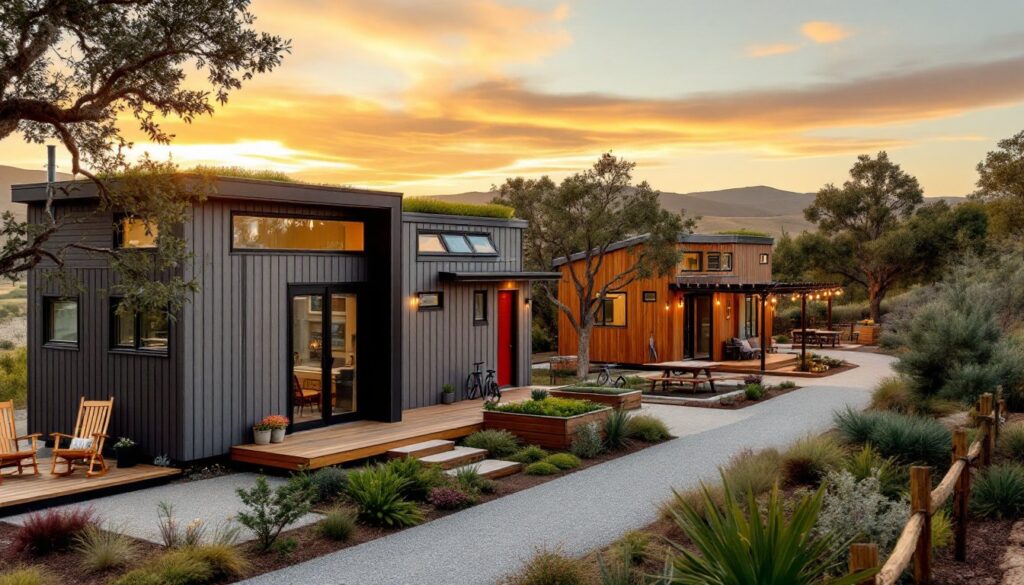
Individual tiny homes solve personal housing challenges, but planned communities are addressing broader affordability and social infrastructure needs. Purpose-built tiny home villages have emerged in metro areas nationwide, offering legally permitted lots with shared amenities, community gardens, workshops, laundry facilities, and gathering spaces. These developments bridge the gap between isolated rural placements and urban density.
Notable projects in 2026 include:
- Portland’s Kenton Village, a 50-unit community with on-site social services and job training programs
- Austin’s Community First. Village expansion, now housing over 400 residents transitioning from homelessness
- Fresno’s Trails End development, offering owner-occupied tiny home lots with full utilities starting under $150,000
These aren’t RV parks with relaxed codes. Most require permanent foundation placement, adhere to IRC standards, and include covenants ensuring design consistency and property value stability. Financing remains tricky, conventional mortgages rarely cover structures under 400 square feet, but some communities partner with credit unions offering specialized tiny home loans or land-lease arrangements.
The real estate trends show increasing investor interest in tiny home developments as workforce housing solutions. Employers in high-cost markets are exploring company-sponsored tiny home communities for staff, while municipalities see potential in converting underutilized parcels into income-restricted tiny home subdivisions. This shift from individual builds to planned communities may be the key to scaling tiny homes beyond enthusiast circles into mainstream affordable housing.
Conclusion
The tiny home movement in 2026 has moved beyond Instagram aesthetics into substantive solutions for housing affordability, sustainability, and intentional living. Regulatory momentum, design maturity, and community infrastructure are converging to make tiny homes a viable choice rather than a fringe experiment. Whether you’re considering a backyard ADU build or exploring full-time tiny living, the landscape has never been more accessible or innovative.